
Blue Panicum, a catalyst for sustainable forage sovereignty
Blue Panicum, a catalyst for sustainable forage sovereignty
Morocco has recorded an average warming of +0.43°C per decade since 1971, amounting to approximately +1.5°C over 50 years. This increase is 11 percent higher than the global average (World Bank, Climate Risk Country Profile: Morocco). During the same period, precipitation has decreased by 4.2 percent per decade, with projections indicating a further national decline of 10 to 20 percent, and potentially reaching -30 percent in Saharan regions by 2050.
At the global scale, soil salinization also represents a major challenge for agriculture. According to the FAO (2022), it affects more than 424 million hectares of surface soils (0–30 cm) and 833 million hectares of subsoils (30–100 cm), severely limiting agricultural production capacities, particularly in arid and semi-arid regions.
In Morocco, soil salinization has become a structural constraint for irrigated agriculture. According to scientific findings published during the 2nd edition of the International Forum on Biosaline Agriculture and Arid Lands (LAFOBA 2), more than 158,000 hectares of irrigated land across the country are already affected. The most impacted areas include Tafilalet (70.4 percent of irrigated land), Ouarzazate (65.9 percent), the Haouz of Marrakech (29.9 percent), the Lower Moulouya (27.7 percent), and Souss Massa (28.8 percent). These figures reflect the magnitude of the phenomenon in arid zones, where poor irrigation practices, intense evaporation and insufficient drainage contribute to the progressive accumulation of salts in the root zone.
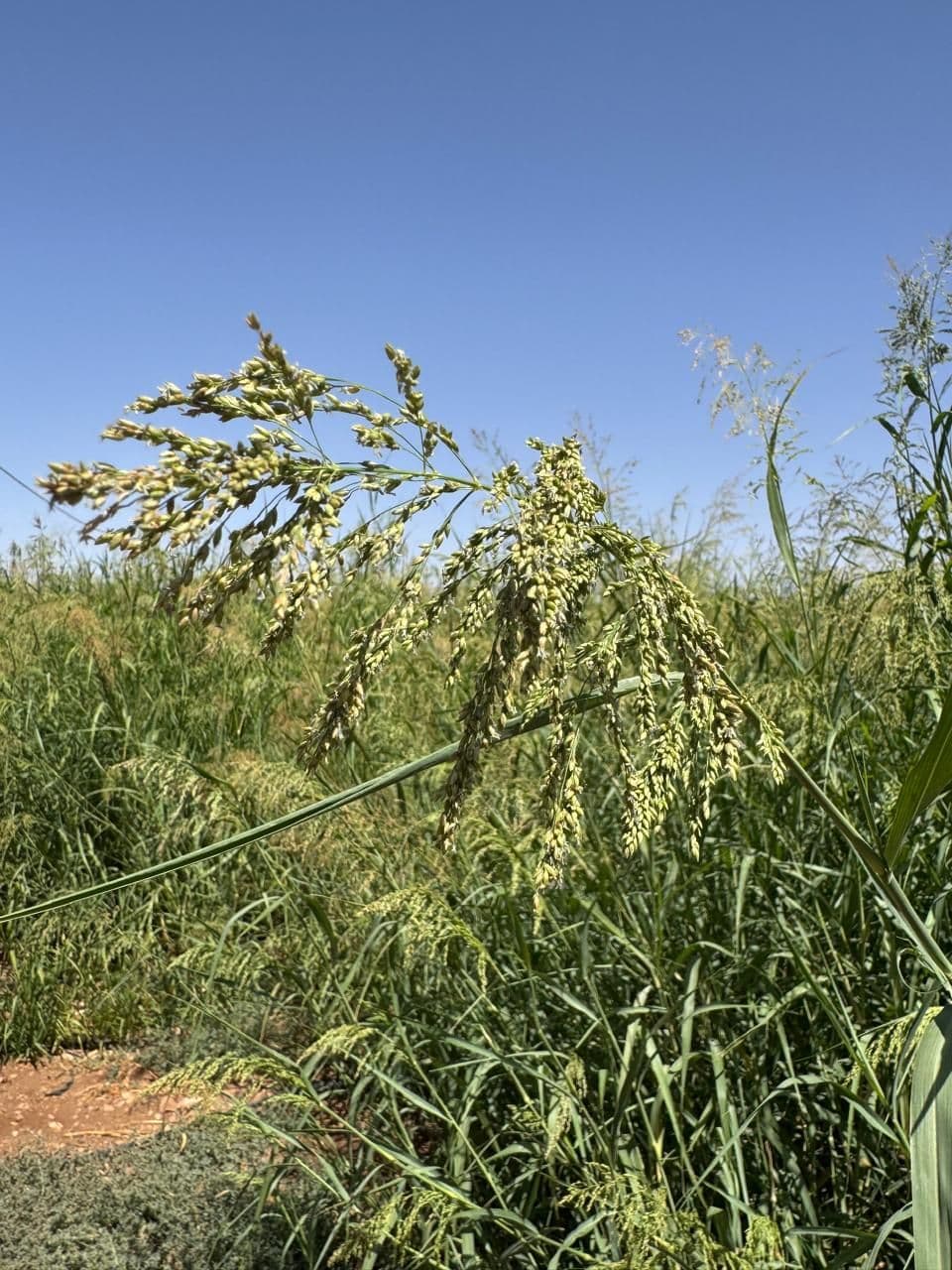
Within this climate emergency, concrete solutions are emerging on the ground. Blue Panicum, a resilient forage crop, is among the most promising examples. Blue Panicum (Panicum antidotale Retz.) is a salt- and drought-tolerant forage grass recently introduced into the Moroccan Sahara to address the fragility of forage systems. Studies conducted by the African Sustainable Agriculture Research Institute (ASARI) at Mohammed VI Polytechnic University (UM6P) show that an integrated agronomic protocol combining ridge planting, root transplantation (instead of direct seeding), organic amendments and legume intercropping can increase yields to 56 tons per hectare per year of fresh biomass, representing more than 50 percent higher productivity compared with control crops in highly saline areas (irrigation water salinity exceeding 10 g/L).
Another study by ASARI researchers, published in Frontiers in Plant Science, recommends cutting Blue Panicum every 40 days to maximize yield and nutritional quality. This approach can produce up to 74 tons of fresh biomass per hectare, 22 tons of dry matter and 2.9 tons of protein even under saline irrigation (irrigation water electrical conductivity = 17 dS/m) while confirming the plant’s salinity tolerance mechanism through a high potassium-to-sodium ratio in the leaves. According to the researchers, these results confirm the central role Blue Panicum can play in the sustainable transformation of forage systems in arid regions. For Professor Abdelaziz Hirich, principal investigator of the project, field observations speak for themselves: “Another success story for the expansion of Blue Panicum in the heart of the Moroccan Sahara. The crop performed remarkably well in a desert environment, resisting multiple stresses, including salinity, wind, drought and high temperatures. This work was carried out by UM6P and ASARI, with the support of the Phosboucraa Foundation.”
Environmental and social impact for local territories
Blue Panicum shows strong potential for rehabilitating degraded lands, particularly in saline and arid environments. Thanks to its deep root system and robust growth under low water input, it contributes to soil stabilization and helps prevent further degradation. Its ability to thrive in hostile environments makes it a promising solution for optimizing the use of marginal lands while reducing pressure on natural resources. But the impact of Blue Panicum extends far beyond environmental benefits. On the ground, this crop is tangibly transforming the lives of livestock breeders and farmers.
This is confirmed by Mohamed Lamine Bakkad, farmer and member of the Sakia El Hamra Cooperative in Laayoune, who has been involved in the project since the early experiments: “We suffer from soil salinity, and even the irrigation water is highly saline. My land had been abandoned, unused. It was Mohammed VI Polytechnic University that came to conduct experiments on several salt-tolerant plants. They discovered that Blue Panicum was perfectly suited to our climate and to our needs as dairy cattle breeders. We were also taught that it must be harvested every 40 days. Today, I cultivate nine hectares thanks to the seeds produced from this experimentation.”
Demonstration platforms supervised by ASARI train livestock breeders, young agronomists and cooperatives in best practices for managing and valorizing this crop. This transfer of knowledge strengthens territorial autonomy and stimulates rural entrepreneurship.
A Pan-African vision led by ASARI
Beyond its local impact, Blue Panicum is part of a broader strategic vision at the continental level. The project contributes actively to advancing forage sovereignty in the arid regions of Africa. Supported by the Phosboucraa Foundation and UM6P, this approach enables ASARI to play a leading role in disseminating adaptable solutions to other African territories facing similar conditions. Blue Panicum has even been showcased as a model during scientific forums such as LAFOBA, highlighting its potential for North Africa and the Sahel.
Professor Hirich also emphasizes the geopolitical significance of this crop: “Biosaline agriculture is becoming a necessity rather than an option. One billion hectares of land worldwide are affected by salinity, including 80 million in Africa and one million in Morocco.”
A Moroccan response to the climate emergency
Blue Panicum is far more than a simple forage crop. It embodies an integrated scientific, social and environmental approach. It symbolizes Morocco’s capacity to transform climate constraints into drivers of innovation. Driven by UM6P’s vision, ASARI’s scientific rigor and the territorial engagement of the Phosboucraa Foundation, this project lays the foundations for regenerative agriculture serving the continent.
Search
Latest Posts
Blue Panicum, a catalyst for sustainable forage sovereignty
10 December 2025
International Camelid Conference
10 December 2025
The 3rd International Laâyoune Forum on Biosaline and Arid Agriculture (LAFOBA3)
10 December 2025
The Second International Forum on Biosaline Agriculture (LAFOBA2)
10 December 2025